Increasing Your Organisational Reach on Twitter Using Marketing Science
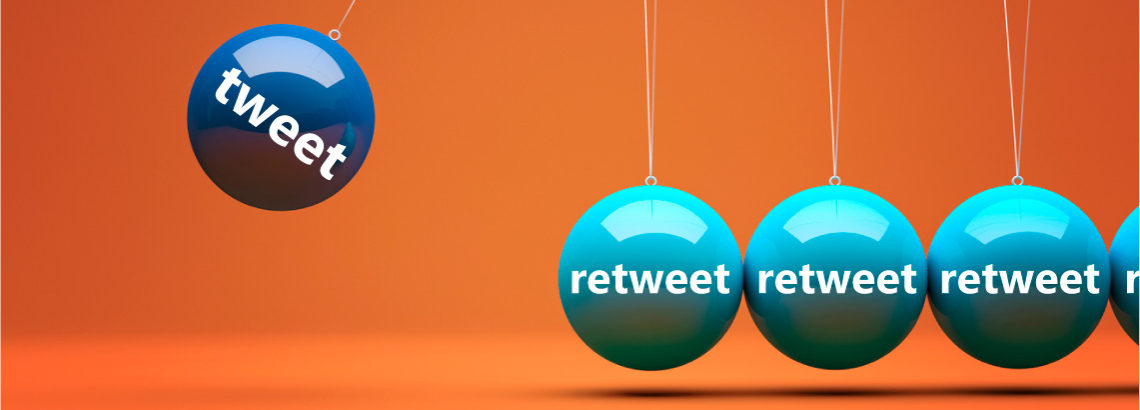
Twitter is an important channel for organisations to communicate with consumers and potential consumers online, and potentially encourage (or ‘seed’) positive word-of-mouth. However, unless an organisation can create engaging messages that followers retweet to non-followers – or provide some other mechanism (such as using popular hashtags) so that non-followers find, read and retweet a tweet, the audience, and the ROI for Twitter communications will be limited. In this study, published in Journal of Marketing Management, we examined the Twitter practices of leading brands, and investigated tweet features that make tweets more likely (or sometimes, less likely) to be retweeted.
What can organisations do to make their tweets reach more people?
A larger number of followers, all else being equal, means that organisation’s tweets will be seen by more people. However, tweet design can also make a big difference to how many people see a tweet because an engaging, interesting tweet can encourage followers to pass the tweet on to others, thus boosting the reach of the tweet for free.
What we discovered
We compared leading brands from three different industries (FMCG -or for those who use American terminology, CPG – Auto and Luxury) and found that what works in one industry doesn’t necessarily work in another. Only two tweet design features (photos and retweet requests) consistently increased the retweet rate across industries. One popular strategy that used to work (including URL links pointing to additional information) consistently decreased the retweet rate. That being said, there are some clear messages for managers, as discussed in the next section.
What are the key takeaways from this study?
As with any strategy, there are no silver bullets: what works for one brand isn’t guaranteed to work for another. However, using some key principles can make it easier to boost organisational Twitter reach:
- You don’t need to tweet much: as few as 3-6 tweets per day seems to be enough to create an engaged Twitter following, many of whom will retweet your most engaging tweets.
- Including hashtags (even up to 4) increases the retweet rate on average, probably because it helps more people see the tweet.
- Using an attractive image in a tweet, or explicitly asking people to ‘Retweet!’ also increase the retweet rate.
- Though early research showed that URL links increase the retweet rate, that doesn’t seem to hold any more: URL links decreased the retweet rate in this study. It’s not clear why, but it’s possibly because URL links (other than those indicating embedded photos or video) distract the user and make it less likely they will retweet the message.
- While it seems intuitively obvious that videos in tweets would increase the retweet rate, the effect of videos in tweets on retweeting was inconsistent across different industries. So, if you want to include videos, do an experiment, and test if videos work in your organisation.
So, what’s next?
We also found some other interesting insights from our analysis. For example, there were different predictors of retweeting across the two high-involvement industries, and these predictors were not consistently different from the low-involvement FMCG industry. This suggests that consumer involvement with the brand on Twitter does not seem to follow the established classification of consumer involvement and needs further research. As mentioned above, future research could also benefit by examining the different types of video included in tweets, to determine if particular types of video are associated with higher (and lower) rates of retweeting. Further research could also investigate the largely unexplored area of initial mentions, and whether third-party mentions and/or self-mentions by brands are most effective in increasing retweet rates.
Read the original research article: Soboleva, A., Burton, S., Mallik, G., & Khan, A. (2017). ‘Retweet for a Chance to…’: an analysis of what triggers consumers to engage in seeded eWOM on Twitter. Journal of Marketing Management. http://dx.doi.org/10.1080/0267257X.2017.1369142

This post is licensed under a Creative Commons Attribution 4.0 International License, unless otherwise stated. Third party materials remain the copyright of the original rightsholder.