Beyond Human Touch: AI Crafting the Next Wave of Luxury
Imagine closing your eyes and thinking about the features of the luxury bag of your dreams. Some images, symbols, and characteristic colours will fade into your head, bringing you back exactly to thinking about that bag. Indeed, each luxury brand has a unique “receipt” of core characteristics and values, which makes its “essence” unique and easily recognizable.
Thanks to these unique “ingredients”, consumers develop emotional bonds (e.g., connections and love/hate relationships) with brands and products, similar to the ones they develop with other consumers or technologies like robots and other anthropomorphized devices.
Specifically, Generative Artificial Intelligence (GAI) can boost creativity in developing new personalised products and shopping experiences.
 Our paper published in the Journal of Marketing Management explores the extent to which GAI tools and Large Language Models (LLM) can design new creative and meaningful bags in the luxury industry, which maintain the typical essence of the brand.
To investigate how GAI employing LLMs can create tangible symbols of luxury in bags, we designed our first study. Here, we selected some of the most iconic luxury bags that are still available in the market from four different luxury brands. In this way, GAI via Midjourney can use those bags as the starting point for designing new ones without understanding the meaning of luxury. Subsequently, we developed the prompts to make GAI generate new bags. Then, four independent experts evaluated the initial set of 100 images, arriving at the 5 most commonly selected images, which were used in Study 2.
Here, thanks to the face-to-face semi-structured interviews conducted in Italy, two main themes emerged. These themes
(i) the ability of AI to reflect the luxury brand essence and
(ii) the emotional bond that GAI-generated products are able to create with consumers.
AI ability to reflect the luxury brand essence
In Study 2a, the adoption of GAI to generate new brands was not perceived by respondents as able to create innovative products, or interruption with the past collections. Indeed, GAI maintained the luxury essence and its symbolic characteristics. Nevertheless, in Study 2b, respondents also identified many similarities with the essence of each brand. For example, they perceived the GAI-designed bags as being in line with their perception of the brand image.
The emotional bond that GAI-generated products are able to create with consumers
Study 2a demonstrated that even when designed by GAI, the luxury bag became a sought-after accessory for consumers to enhance their outfits, eliciting positive emotional responses. Furthermore, respondents assumed that the materials used for these new bags would be the same as those used for the other bags, thus maintaining the same level of craftsmanship and quality. Consequently, they believed that the same level of care would be required.
In Study 2b, the participants expressed reservations about the colours and creative choices expressed in the new bags. This sentiment gives rise to the notion that donning one of these bags may potentially induce a sense of unease. Nevertheless, the interviewees indicated that these bags can still be perceived as a symbol of high social status and that they would like to own them regardless of their specific aesthetic appeal.
Fear of human creativity replacement with AI
Following the revelation to participants of Study 2b that the bags were GAI-generated, their initial response was one of astonishment, given their assumption that the bags had been created through an intense creative process by humans. Furthermore, respondents indicated that the incorporation of GAI does not significantly alter the fundamental essence of these brands, which remains consistent with past collections.
A call for managers to implement GAI in developing new products
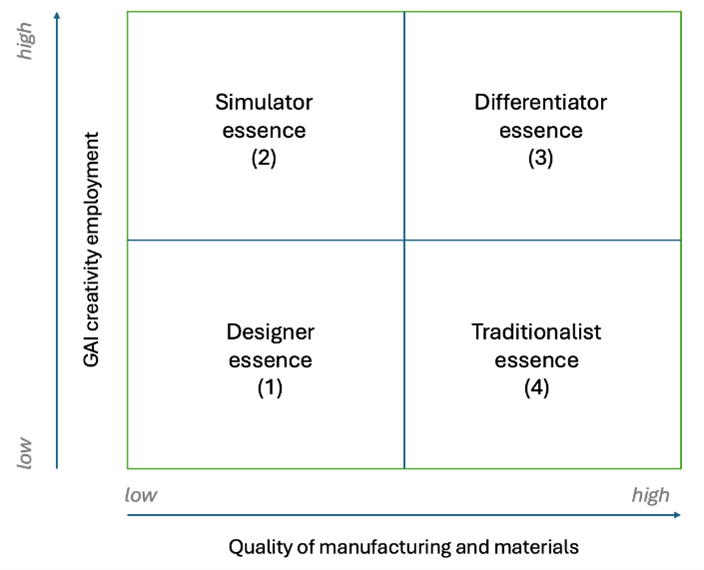
In light of these findings, it is incumbent upon managers to recognize that the design will no longer serve as the primary factor differentiating the product, given the pervasive nature of GAI. Consequently, the differentiating factor will be largely contingent upon the quality of the manufacturing process and the materials used.
In other words, GAI tools provide a significant opportunity for creativity, which competitors in both luxury and non-luxury sectors may leverage to replicate the essence of luxury products with relative ease. Consequently, the utilization of GAI in product design can yield four distinct scenarios (Figure 1), contingent on the degree of GAI creativity employed in the design process and the quality of manufacturing and materials utilized in the production of the product or brand.
Figure 1 The product/brand essence matrix (authors’ elaboration)
Read the original research article: Pantano, E., Serravalle, F. & Priporas, C.-V. (2024). The form of AI-driven luxury: how generative AI (GAI) and Large Language Models (LLMs) are transforming the creative process. Journal of Marketing Management, 40(17-18), 1771–1790. https://www.tandfonline.com/doi/full/10.1080/0267257X.2024.2436096

This post is licensed under a Creative Commons Attribution 4.0 International License, unless otherwise stated. Third party materials remain the copyright of the original rightsholder.